
Lege et Lacrima II

OLYMPUS DIGITAL CAMERAVah! Denuone Latine loquebar? Me ineptum. Interdum modo elabitur – Oh! Was I speaking Latin again? Silly me. Sometimes it just sort of slips out.

I just wanted to remind you of the campaign I proposed a short while ago, in case you had forgotten about it. I’m still keen to revive the so-called dead language and you may remember my outlining the distinct advantages (and some pitfalls, unfortunately) of resurrecting its universal usage.

One of the unfortunate advantages (at least from the standpoint of the drive for awareness) is that, on the assumption that he/she is not fluent (as you are) you can be quite rude to or dismissive of someone without them realising. In fact, because, as I have mentioned before, however banal, surreal or outlandish the statement, Quid quid latine dictum sit, altum videtur – Anything said in Latin sounds profound.

For example – oops, e.g.Verveces tui similes pro ientaculo mihi appositi suntI have twits like you for breakfast; Tua mater tam antiquior ut linguam latine loquaturYour mother is so old she speaks Latin; Sic friatur crustum dulceThat’s the way the cookie crumbles. Nowhere is it more demonstrable then in phrases such as Ubi est mea anaticula cumminosa?Where is my rubber duck? Semper ubi sub ubi ubiqueAlways wear underwear everywhere; Te audire non possum. Musa sapientum fixa est in aureI can’t hear you. I have a banana in my ear; Oblitus sum perpolire clepsydras!I forgot to polish the clocks! Omnes lagani pistrinae gelate male sapiuntAll frozen pizzas taste lousy; In dentibus anticis frustrum magnum spiniciae habesYou have a large piece of spinach in your front teeth; Loqueris excrementum – You are talking shit.

I have considerable support for the renaissance advocated, in the person of the great Roman poet Publius Ovidius Naso (20 March 43 BC – AD 17/18) – Ovid to you – who once said: Rident stolidi verba latinaFools laugh at the Latin language – and everyone, but everyone, always used to listen to him. And they still do – you only have to look at any public school curriculum (see? You can’t get away from it).

In my earlier treatise, I suggested that the dialogue in films could be considerably romanticised by speaking them in Latin; I have found a few more examples to bolster this contention: Ire fortiter quo nemo ante iitTo boldly go where no man has gone before; Te capiam, cunicule sceleste!I’ll get you, you wascally wabbit!  Tu, rattus turpis!You dirty rat! Re vera, cara mea, mea nil refertFrankly my dear, I don’t give a damn; Luke sum ipse patrem teLuke, I am your father; Revelare pecunia!Show me the money! Pistrix! Pistrix!Shark! Shark! (shouted in Jaws, surely?); Farrago fatigans!Suffering succotash! Latro! fremo!Woof woof! Grrrr! (Lassie).

You may remember that jokes relying on the vagaries of the English language don’t work (remember I scream, you scream, we all scream for ice cream?); well, neither do tongue twisters: Quantum silvam modio picus si posset picus silvam modio?How much wood would a woodpecker peck if a woodpecker could peck wood? Pietro Fistulator lectis modii capsicum conditaneum, ubi modii capsicum conditaneum  quod lectis Petro Fistulator? Peter Piper picked a peck of pickled pepper, where’s the peck of pickled pepper Peter Piper picked?  Corio rubeus, corio flava, corio rubeus, corio flava– Red leather, yellow leather, red leather, yellow leather… Vendit concha mare in litum marum She sells seashells on the seashore;  Vigilum publicorum Lethium nos dimitte The Leith police dismisseth us. See? Almost ridiculously easy to enunciate, I think you’ll agree.

Well, there you are, keep practising the lingo (from the Latin lingua – tongue or language); It’s got a lot to answer for, hasn’t it?
Lege et Lacrima I

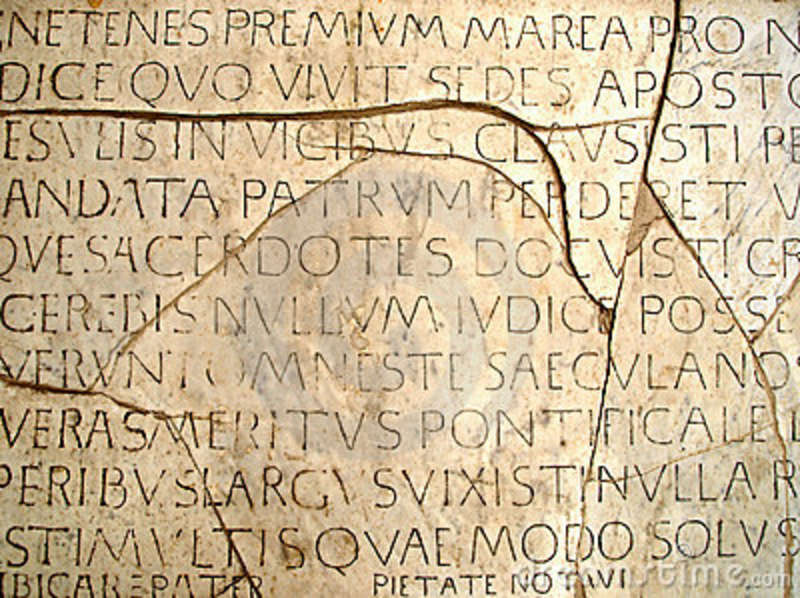
latin-writingI would like to share with you some linguistical research I have been undertaking and talk to you about (and, at several junctures, in) Latin. I hold up my hands and admit that, although I am guilty of most of the English phrases, I am not responsible for the actual translations.

Some say it’s a dead language, but only its usage is dead and I think it should be revived by dragging it into the 21st Century. It’s all very well for people like René Descartes to come up with stuff like cogito ergo sum (I think therefore I am) and in probably quite a smug way, as if to say when people looked mystified, bene, cum Latine nescias, nolo manus meas in te maculare (well, if you don’t understand plain Latin, I’m not going to dirty my hands on you). Or even more ancient bores like Horace: aequam memento rebus in arduis servare mentem (remember when life’s path is steep to keep your mind even). What we should be doing is looking at ways to modernise Latin which, you have to agree, has a wonderfully profound feel to it no matter what its meaning: sic transit gloria mundi (so passes the glory of the world) looks and sounds as impressively romantic as sona si latine loqueris (honk if you speak Latin) or braccae illae virides cum subucula rosea et tunica caledoniaquam eleganter concinnatur! (those green trousers go really well with that pink shirt and plaid jacket!)

There will inevitably be some drawbacks to achieving the renaissance I am advocating and I think we’ll have to forget some of the jokes that rely on the idiosyncracies of the English language as they simpy don’t translate effectively: for example, clamo, clamatis, omnes clamamus pro glace lactis (I scream, you scream, we all scream for ice cream) – it’s a great shame! However, this sad state of affairs is rescued to a degree by the nature of some of the more bizarre insults I’ve come across in my research, apparently in common use in the ancient Roman culture: such as mater tua criceta fuit, et pater tuo redoluit bacarum sambucus (your mother was a hamster and your father smelt of elderberries); or ripostes to recalcitrant Roman teenagers: antiquis temporibus, nati tibi similes in rupibus ventosissimis exponebantur ad necem (in the good old days, children like you were left to perish on windswept crags).

It would be nice to be able to cover many of life’s modern eventualities with a choice Latin phrase; here is a selection of some common ones: Balaenae nobis conservandae sunt! (Save the whales!); Braccae tuae aperiuntur (Your flies are undone); Capillamentum? Haudquaquam conieci esse! (A wig? I never would have guessed!); Catapultam habeo. Nisi pecuniam omnem mihi dabis, ad caput tuum saxum immane mittam (I have a catapult. Give me all your money, or I will propel an enormous rock at your head); Da mihi sis bubulae frustrum assae, solana tuberosa in modo gallico fricta, ac quassum lactatum coagulatum crassum (Give me a hamburger, french fries, and a thick milk shake); Die dulci freure (Have a nice day); Ducator meus nihil agit sine lagunculae leynidae accedunt (My calculator does not work without batteries); Duco ergo sum (I calculate therefore I am); Cogito ergo doleo (I think therefore I am depressed); Veni vidi visa (I came, I saw, I shopped); Interdum feror cupidine partium magnarum europe vincendarum (Sometimes I get this urge to conquer large parts of Europe).

So why not join me in attempting to revive a flagging interest in the language and bring it into everyday conversation? When you need an excuse to leave, say Cum homine de cane debeo congredi (Excuse me, I’ve got to see a man about a dog); after you’ve tried to contact someone unsuccessfully: Sane ego te vocavi. Forsitan capedictum tuum desit (I did call. Maybe your answering machine is broken); when you want to make a wise pronouncement at a summer barbecue party with friends: Animadvertistine, ubicumque stes, fumum recta in faciem ferri? (Have you ever noticed how, wherever you stand, the smoke goes right into your face?); or just an introductory platitude (definitely not a chat-up line, though) Vidistine nuper imagines moventes bonas? (Seen any good movies lately?). On the subject of movies, wouldn’t it be much better if the dialogue was in Latin? “Certe, toto, sentio nos in kansate non iam adesse” (“You know, Toto, I have a feeling we’re not in Kansas anymore”); Credidi me felem vidisse! (I tought I taw a puddy tat!); Me transmitte sursum, caledoni (Beam me up, Scotty).

By the way, the heading means “read it and weep” – too late a warning, I suspect.